
In honor of all the political conversations which were held at 45 Nepa Line, Aba, every evening, by ordinary citizens whose power did not exceed the walls of the compound. This essay is written in remembrance of the spirit of community that swept through the compound from 2015 till 2022 when we moved out.
I grew up observing our many Igbo dialects. I grew up in Aba where there is a mixture of many Igbo dialects, and now I think of how distinct and beautiful these dialects are. Despite the existence of these many Igbo dialects, there is an effort by all the Igbo people in Aba to speak the Aba brand of Igbo, irrespective of their own original dialects, as long as they live in Aba.
Aba is a developing town in Eastern Nigeria which holds many Igbo people together. The original owners of the land are the Ngwa people, but many other Igbo people from different parts of Igbo land migrated to Aba in search of jobs and businesses to do after the Biafran war ended. The Ngwa people had spacious lands, and so they made good fortune by selling parts of their lands to their fellow Igbos who had migrated from different parts of Àlà Igbo. The war had just ended, and people needed to find new ways to survive, and one of those new ways to survive was the immigration of many Igbos from their remote villages into more known and more urbanized Igbo communities like Aba. Within the space of ten years after the end of the war, many Igbos had stood up again on their feet in their businesses, and today, most of the houses and top-performing businesses in Aba are owned by these non-Ngwa people, people who came uncertainly, people who are not the original owners of the land. The Igba-Boi system also thrived during that period, and it helped in the expansion of many local businesses. Ịgba-Boi is a practice in which young men who have no opportunity to be in school are sent to men who are established in businesses. They live with the men for many years, learning their businesses. After some years, the master would settle them by helping them establish that same business somewhere else in the same market or city. It does not always end well for some people; their masters might accuse them of stealing, or accuse them of a very disturbing crime, and then chase them away. It is depicted in Chukwuebuka Ibe’s 2024 novel, Blessings. Presently in Igbo land, there are also many stories of young men who became frustrated and depressed after being chased away empty-handed by their masters.
I grew up in a home where we were raised with the Abiriba tongue. There is a way we say, “Go and take your bath” which is very different from how the other Igbo dialects say theirs. I’m still grateful that my parents unapologetically spoke our mother tongue to us as children. There was no English. English was what happened in school only. Even now, we speak the Abiriba dialect in my family, both in public and at home. My parents are semi-educated, and I don’t think that is the reason why they only spoke our mother tongue to us, because even today, parents who aren’t educated at all are speaking a mangled, terrifying English to their children, instead of grounding them in the Igbo language. My parents’ decision to speak our mother tongue to us stems from their love for the Abiriba Kingdom where they were born and raised, a kingdom they often talk about and defend only in glowing terms. It stems from my father’s awareness of the destructive power of politics, that one of the ways through which greater powers disarm people of lesser powers is by slowly eradicating their language, the very thing that made the Kenyan writer, Ngugi Wa Thiongo to stop writing in English, and then began to write in Kukuyi, his native language. It stems from his belief in the equality of all peoples. Even if they were well educated, I strongly believe they would have still raised us with the Abiriba dialect. My father is an unknown activist. You should see him soliloquizing to himself on the daily news of killings in Nigeria. You should see him talking about Biafra. You should see the yearning in his voice, a yearning for things to be in order, a yearning for global justice and peace. You should see him singing Bob Marley and Lucky Dube’s songs line by line, songs I find difficult to understand because of the generation I’m born into, songs that my father consider as very prophetic. I have no doubts, my parents are real Africanists, my father especially, and that was why they only spoke our mother tongue to us.
We lived close to Anambra people while I was growing up and their dialects are quite very similar to each other, and so we simply classified them as “Ndị Anambra”. Having heard people speak in the Anambra dialects, I was so happy when I saw the dialects used in writing, in Chinua Achebe’s Things Fall Apart, and then in all of Chimamanda Ngozi Adichie’s books, an act she had confirmed to be very deliberate as her way of returning dignity to the Igbo language, and its people. After the defeat of the Igbos in the war, a subtle shame hung over every Igbo person living in Nigeria. More Igbos started giving their children English names, to make them less Igbo. More Igbo parents started speaking English to their children at home, to make them become as European as possible. More Igbo people became interested in education, just to meet up to whatever the war might have taken away from them as legitimate citizens of Nigeria who rebelled against their country, and then became reintegrated back into the same country they fought against. The average Igbo person living in Nigeria became a dire hustler, making sure to occupy his space, making sure to survive. If a family owned any lands, they would be very happy and satisfied to sell the lands just to make sure that their child or children had university degrees. More Igbo people began to send their children abroad to study. In Nigerian civil offices, the Igbos began to minimize being Igbo. They made sure to only speak English to you, even when it was very evident that the person they were talking to was also Igbo. Igbos began to perform a certain kind of forced Nigerianness, a refusal to be reminded for whatever reason that they were the defeated people.
Both Chinua Achebe and Chimamanda Ngozi Adichie are from Anambra state, Eastern Nigeria. Renowned Nigerian writer, Chukwuemeka Ike, author of Sunset At Dawn, was also from Anambra state. Discovering this familiar Igbo tongue in their books was blissful. I remember feeling so joyful after reading Purple Hibiscus. I had read so many novels before Purple Hibiscus, but there was something different about this particular novel. The blend of Igbo and English languages in the novel resonated so deeply with me because I had been yearning to read such work in Nigerian literature, and so purple Hibiscus came as an answer to my question. To me, Purple Hibiscus was a great work of art because it mirrored the way many Nigerians spoke: in a mixture of many tongues. And to discover that the book garnered great international acclaim was also very thrilling. Purple Hibiscus was not just a book. It was the evidence of what it meant to be a Nigerian living in the post-Biafran war Nigeria, especially as an Igbo who was formerly a Biafran. According to Adichie, her editors told her to remove the Igbo dialects and she totally refused. As a young Nigerian writer trying to publish her first novel in the early 2000s United States, it was the most audacious and risky thing to do. I still respect her for standing on her ground: Igbo language is also a language worthy of respect and dignity.
Here in Aba, there is the Bende dialect, which includes people from Ùgwùeke, Alayi, Igbere, Ozuitem, and Item. Their dialects are very similar, and so they are classified under the Bende dialect. If you are not careful, you wouldn’t be able to differentiate between one from the other. I can differentiate between the Ùgwùeke and Igbere dialects from anywhere, but they are very much similar to each other. I’ve been close to people who speak them. Because I’ve always been a lover of words, I was observing the differences in tones and meanings when people speak in their dialects. There is a huge difference between the Abiriba and the Nkporo dialects, both in the same state – Abia state – where I come from. History has it that the Abiriba and Nkporo people had once been together years ago before the creation of Nigeria, until they set boundaries for themselves. They still live a bit close to each other, but now as different communities, with different dialects.
The strangest Igbo dialect I know is the Ohaozara. If you are not attentive, you won’t even know that they are speaking Igbo. Their words run faster into each other. Their words are more in a hurry, like an impatient driver desperately wanting to arrive at their destination as soon as possible. They speak too fast, words rushing forth, very musical. Later, we would live with the Edda people in the same compound. Their dialect stands on its own. They live in groups in Aba, and are very communal, always looking out for each other. I can speak a bit of it. I love to listen to them when they speak. And it’s beautiful. My family once lived in a compound steeped in the love for Biafra when Nnamdi Kanu was still very active on Radio Biafra. The Edda people who lived in the same compound with us were very vocal about their support for Nnamdi Kanu and about their dream for a separate country. It was a very heated period of killings in the Northern Nigeria. Nnamdi Kanu would come on air every other evening and lambast the Nigerian government for being so ominously quiet toward the killings. The Edda people would rant in their Edda dialect and I would sit down and listen. It was very beautiful discovering them. If we had not lived in that compound, perhaps I wouldn’t have known how distinct and peculiar their dialect is. Living in that compound shaped how I would later view the world. I didn’t know it at that time, but hearing the ordinary Nigerians air their grievances to nobody in particular planted something in me which I wouldn’t discover until I started writing years later. It was also in that compound that I reread Adichie’s Half Of A Yellow Sun over and over again. I was eighteen, and I wanted to understand Biafra. I wanted to know in full what it was that Nnamdi Kanu was fighting for. I wanted to know the origin of his agitation. It was painful and heartbreaking hearing about the injustices happening in Nigeria, the killings in the North, the attack and the killings of the IPOB members. It was too painful, the voice of Nnamdi Kanu. On some days, he simply restrained himself from crying. I couldn’t see him live because it was a radio, and not a television, but I knew when someone was trying all he could not to break down. There were days when he came on air with a very heavy heart, and his voice always drew my attention, even though I never joined in the conversations going on, even though I did not understand everything that was being said as I do now. I would sit in their midst and listen to them analyze whatever Nnamdi Kanu was saying on radio. I would listen to them bemoan the silence of the world toward the present agitation for Biafra, and more importantly the killings perpetrated by bandits in different parts of Nigeria. I would listen to them talk about the 1960s Biafra, and my curiosity enlarged. After the radio broadcast each evening, I would go inside our house and continue reading Half Of A Yellow Sun. I wanted to know and understand everything, right from when it started.
Nobody pays attention to these dialects because on formal occasions we only speak the Igbo Izugbe – the standardized Igbo, which can be very clumsy in the mouth, especially the type they write books with, in the few Igbo books we have. And they speak it on radio too. A very formal, rules-abiding Igbo that every Igbo person can understand no matter the dialect you speak in your house. But sometimes it can sound so bland because it is not what people speak with in their homes. A new US journal – Purple Stallion Review – recently published my poem in their very first issue, and the poem is about language. I called it “Outside The Niceties Of Formal English”. In it I talked about how I speak the Aba brand of Igbo everyday in my life. I do not go about speaking English, although recently I’ve started having more English words slipping out of my mouth. I guess the more you study and read in English, the more difficult it becomes to completely speak your mother tongue. But I’m trying. It’s a hard fight. When I’m out in public, I speak the Aba brand of Igbo, because that’s what everyone speaks. And this Aba brand of Igbo is simply a mixture of many things. It’s a mixture of the ancient Igbo, modern Igbo street slangs, many Igbo dialects, and different Nigerian languages. All these things came together and became the Aba brand of Igbo, which has never been used in formal writing. I see some people on Facebook who write with it sometimes. It’s very informal, very casual, very breezy. It doesn’t have the heaviness and seriousness of the Igbo Izugbe. But we speak it, and we understand ourselves. That’s what the poem is about. The editor loved it so much, wanted to send me a hard copy of the book all the way from the US to Nigeria, but I said I was okay with the pdf.
I listen to different Igbo dialects and marvel at what God has done. Is it the Ngwa and Owerri dialects? I love the Ngwa more when they are having arguments. I love the sound of ‘gbo’ which features in their speech every now and then. I’m familiar with the Owerri dialect through songs. It seems they are too blessed by the spirit of songs. Their songs are very beautiful. There are many popular Igbo singers who only sing in the Igbo Izugbe, but the Owerri people sing in their Owerri dialect. Because there has been many successful Igbo songs which have been beautifully recorded in the Owerri dialect, many more songs are being done in this beautiful dialect, and the rest of the Igbo people have given them a pass. We all understand the Owerri dialect of course, but they don’t have this tendency to restrain their dialects in songs like many other Igbo people do. Popular Igbo gospel singer, Paul Nwokocha, is from my hometown, Abiriba, but he sings in general Igbo. If you sing in the Abiriba dialect, it wouldn’t be considered as ‘mainstream’ because it hasn’t been popularized. Maybe only you and your village people would buy and listen to the song if you tried to record a full song in the Abiriba dialect. It wouldn’t attract a large market. The Abiriba dialect still needs more heft in musical popularity and acceptance, which the Owerri dialect has successfully attained. And maybe the Abiriba people and other Igbo people of minor dialects should try singing in their own dialects, whether the songs make great sales or not. I suppose it must have been the way by which the Owerri people attained their solid musical acceptance and recognition in Eastern Nigeria. I suppose they sang the songs in their own dialect because they were passionate to sing, and not only about making money, until the Owerri dialect became known and recognized, and also began to generate income for the singers or performers. Maybe one of the greatest problems of being a human being living in the 2020s is that everything has become about money. The success of everything is now determined by how much money that is made.
There is this popular album beautifully done in the Owerri dialect which my parents love so much. The most popular song from the album is “Oge chi ka mma” – God’s Time Is The Best. My parents love the song, and we once owned the plate when VCD was still a thing. We are not from Owerri, but we played the songs in our house, songs deeply steeped in the Owerri dialect that some meanings elude us, but it was a work of art, very artistic and beautiful, which means we can do and achieve many more things if we were given the tools to do so, if we try more. If the Igbo language was given more value, it would have done better than it has done today. People would have read more in Igbo, people would have written more in Igbo, people wouldn’t be ashamed to speak Igbo to their children in public. And It’s time we begin to place more value on our dialects and not feel ashamed of them. Our language and dialects are valid too. Just like English.
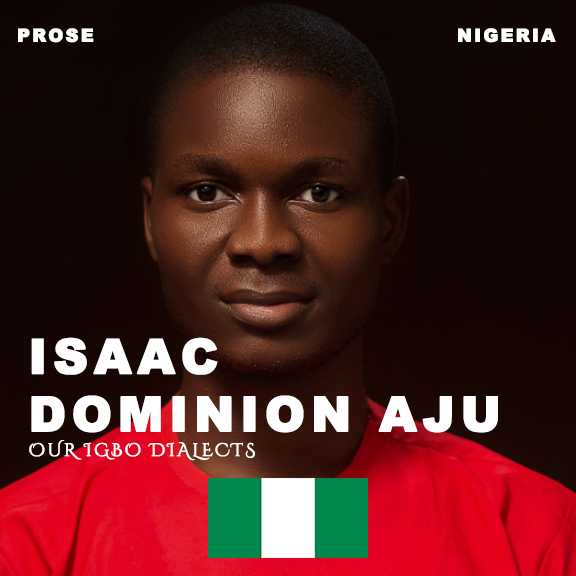
Isaac Dominion Aju has appeared in international journals such as Poetry X Hunger, Flapper Press, Asemana Magazine, Steel Jackdaw Magazine, All Your Poems Anthology. He lives in Nigeria where he works as a fashion designer.